
Views: 2 Author: Site Editor Publish Time: 2026-06-29 Origin: Site


Managing the daily flow of linens, towels, and uniforms is one of the most demanding operational challenges in any hospitality, healthcare, or commercial facility. The efficiency of your housekeeping and maintenance staff relies heavily on the equipment they use to collect, transport, and organize these materials. Choosing the right Laundry Cart is not merely a matter of purchasing a basic utility item; it is a strategic decision that impacts workplace ergonomics, operational speed, and overall hygiene standards. A well-designed cart can streamline workflows, reduce physical strain on employees, and ensure that soiled linens are handled in a manner that prevents cross-contamination. Conversely, inadequate equipment can lead to bottlenecks, increased labor costs, and potential safety hazards. In this comprehensive guide, we will explore the essential factors to consider when selecting the ideal equipment for your facility, examining everything from frame construction and wheel dynamics to bag configurations and storage solutions.
A professional-grade laundry cart is essential for efficient facility management and linen transport.
In the fast-paced environment of a modern hotel, resort, or hospital, the laundry collection process must be executed with precision and reliability. The sheer volume of textiles processed daily requires robust systems and durable equipment. A high-quality transport solution serves as the backbone of this system, enabling staff to move large quantities of heavy, often damp, linens across vast floor plans with minimal effort. Understanding the multifaceted role of these carts is the first step in making an informed purchasing decision.
Operational efficiency is the cornerstone of profitable facility management. Every minute spent struggling with a poorly functioning cart is a minute lost from productive tasks. When staff are equipped with reliable, easy-to-maneuver equipment, they can complete their collection and distribution routes more quickly. This efficiency translates directly into labor savings and allows housekeeping teams to service more rooms or areas within their shifts. The design of the cart plays a pivotal role here; features such as appropriate height, accessible bag openings, and smooth-rolling casters all contribute to a frictionless workflow. Furthermore, carts that offer sorting capabilities at the point of collection eliminate the need for secondary sorting in the laundry room, saving considerable time and reducing handling.
The physical well-being of facility staff is a paramount concern. Pushing, pulling, and lifting heavy loads of laundry can lead to musculoskeletal disorders and fatigue if the equipment is not ergonomically designed. A properly engineered cart minimizes the physical exertion required to initiate movement and maintain momentum, even when fully loaded. The height of the frame should allow users to push the cart without bending or straining their backs. Additionally, the inclusion of reliable braking systems ensures that the cart remains stationary when parked on inclines or during loading and unloading, preventing accidental roll-aways that could cause injuries or property damage. Investing in ergonomic equipment is an investment in the health and longevity of your workforce.
In both hospitality and healthcare settings, maintaining strict hygiene standards is non-negotiable. The transportation of soiled linens presents a continuous risk of cross-contamination if not managed correctly. Carts must be designed to contain moisture, odors, and potential pathogens effectively. This is where the quality of the bags and their linings becomes critical. Materials that resist moisture penetration prevent damp towels or soiled sheets from leaking onto the floor or contaminating the cart's frame. Furthermore, the ability to easily remove and clean the bags, as well as sanitize the frame, is essential for maintaining a hygienic environment. Proper equipment design supports facility-wide infection control protocols and ensures a safe environment for both guests and staff.
With a myriad of options available on the market, selecting the appropriate equipment requires a careful evaluation of your facility's specific needs and the features offered by different models. It is essential to look beyond the basic functionality and assess the durability, capacity, and maneuverability of the cart. By breaking down the selection process into key categories, facility managers can make objective comparisons and choose a solution that delivers long-term value.
The frame is the structural foundation of the cart, dictating its weight capacity, longevity, and resistance to the rigors of daily commercial use. Materials must be chosen for their ability to withstand constant movement, occasional impacts, and exposure to moisture and cleaning chemicals. While plastic and aluminum options exist, steel remains a preferred choice for heavy-duty applications due to its superior tensile strength and rigidity. A well-constructed frame will maintain its alignment over time, ensuring that the wheels continue to track straight and the cart remains stable under load. The finish applied to the frame is equally important, as it protects the underlying material from corrosion and wear while contributing to the overall professional appearance of the equipment.
The configuration of the collection bags directly impacts the efficiency of the sorting and transportation process. Facilities must consider the volume of laundry generated and the necessity for pre-sorting. Single-bag carts may be sufficient for small operations or specific tasks, but multi-bag configurations offer significant advantages for larger facilities. Having separate compartments allows staff to sort linens by type, color, or soil level at the point of collection. This pre-sorting drastically reduces the handling required in the central laundry facility, streamlining the washing process. The capacity of the bags must also align with the physical capabilities of the staff; bags that are too large may become dangerously heavy when filled with damp linens, while bags that are too small will require excessive trips to the laundry room.
The mobility of a cart is entirely dependent on the quality and configuration of its wheels. In a commercial setting, carts must navigate narrow corridors, transition between different flooring types (such as carpet to tile), and maneuver in tight spaces like elevators and storage closets. Universal wheels, which can swivel 360 degrees, provide the necessary agility for these environments. The material of the wheel tread affects both the ease of rolling and the potential for floor damage; non-marking materials are essential to preserve the appearance of facility floors. Additionally, the integration of braking mechanisms is a critical safety feature, allowing the cart to be securely parked during use.
Space is often at a premium in facility storage areas and housekeeping closets. Equipment that consumes excessive floor space when not in use can create clutter and impede operational efficiency. Therefore, the physical footprint of the cart, both assembled and disassembled, is a vital consideration. Designs that allow for easy disassembly or folding can significantly optimize storage space. This feature is also highly beneficial during the initial transportation and delivery of the equipment, as it reduces shipping volumes and associated costs.
The choice of frame material is one of the most critical decisions in the design and selection of commercial transport equipment. The material must balance strength, weight, corrosion resistance, and aesthetic appeal. Understanding the properties of different materials helps facility managers select equipment that will endure the demanding conditions of their specific environment.
Plastic frames are lightweight and impervious to rust, making them suitable for light-duty applications or environments with extreme moisture. However, they often lack the structural rigidity required for heavy loads and can become brittle over time. Aluminum offers an excellent strength-to-weight ratio and natural corrosion resistance, making it a popular choice for aviation and healthcare applications where weight is a primary concern. However, aluminum can be susceptible to denting and bending under severe impact. Steel, on the other hand, provides unmatched durability and load-bearing capacity. It is the material of choice for heavy-duty commercial applications where the equipment will be subjected to constant, rigorous use. While raw steel is susceptible to rust, proper surface treatments and finishes can completely mitigate this issue, resulting in a frame that offers both exceptional strength and longevity.
When utilizing steel for cart construction, the specific form and finish of the material play a crucial role in its performance. Tubular steel is highly favored because the cylindrical shape provides excellent structural integrity and resistance to bending forces from all directions, while remaining relatively lightweight compared to solid steel bars. Furthermore, a polished finish serves multiple purposes. Aesthetically, a polished steel tubular frame presents a clean, professional, and high-end appearance, which is particularly important in hospitality settings where the equipment may be visible to guests. Functionally, the polished surface is smooth and non-porous, making it exceptionally easy to wipe down and sanitize. It also provides a protective layer that helps resist scratches, scuffs, and minor impacts that occur during daily operations.
The bags attached to the frame are the primary interface between the equipment and the linens being transported. The design, material, and configuration of these bags are critical to maintaining hygiene, protecting the frame, and facilitating efficient workflows. Facility managers must pay close attention to the specifications of the bags to ensure they meet the operational demands of their staff.
In almost any commercial laundry scenario, staff will encounter damp or wet linens. This is especially true in hotels with pool facilities, spas, or simply from the collection of used bathroom towels. If the collection bags are made of porous materials, moisture can easily seep through. This seepage not only creates an unpleasant and potentially hazardous dripping mess on facility floors but also exposes the cart's frame to continuous moisture, accelerating wear and potential corrosion. A waterproof lining is therefore an essential feature. It acts as an impenetrable barrier, containing all moisture within the bag. This protects the structural integrity of the cart, maintains clean floors, and ensures that odors and potential contaminants are securely contained during transport.
Efficiency in the laundry room begins at the point of collection. Carts equipped with multiple, distinct bags offer a significant operational advantage by enabling immediate sorting. For example, a cart featuring two separate bags allows housekeeping staff to instantly separate standard white bed linens from colored towels or heavily soiled items. Utilizing visually distinct bags, such as one brown and one black bag, provides a clear, unmistakable visual cue for staff, reducing sorting errors. This dual-bag system streamlines the entire laundering process, as the pre-sorted bags can be emptied directly into the appropriate washing machines without the need for secondary, labor-intensive sorting on the laundry room floor. This not only saves time but also reduces the physical handling of soiled linens, improving overall hygiene.
The wheels, or casters, are arguably the most critical moving parts of any transport cart. They bear the entire weight of the load and dictate how easily the equipment can be maneuvered by the user. Poor quality wheels can render even the most robust frame useless, causing immense frustration and physical strain for the staff. Understanding wheel dynamics is essential for selecting a cart that operates smoothly and safely.
In complex environments like hotels or hospitals, carts rarely travel in straight lines. They must navigate around corners, through doorways, and around obstacles in hallways. Universal wheels, also known as swivel casters, are designed to rotate a full 360 degrees. When a cart is equipped with 4 universal wheels, it achieves maximum maneuverability. This configuration allows the cart to be pushed forward, pulled backward, or moved laterally with equal ease. Staff can easily pivot the cart in tight spaces, such as inside a guest room or a crowded elevator, without having to forcefully drag or lift the equipment. This omnidirectional movement is crucial for reducing physical strain and increasing the speed of collection routes.
While ease of movement is vital, the ability to securely stop and hold the cart in place is equally important for safety and operational efficiency. A fully loaded cart can carry significant momentum and weight. If left unattended on even a slight incline, it can roll away, potentially causing injury to guests or staff, or damaging walls and furniture. Therefore, equipping the cart with reliable brakes is a necessity. A configuration that includes 2 wheels with brakes provides a secure parking solution. When the brakes are engaged, the cart is locked in position, allowing staff to safely load or unload linens without the equipment shifting away from them. This stability is essential for maintaining a safe and controlled working environment.
The lifecycle of a commercial cart begins before it even arrives at the facility and continues through years of daily use. Considerations regarding how the equipment is shipped, assembled, and maintained are critical factors in the overall cost of ownership and operational viability.
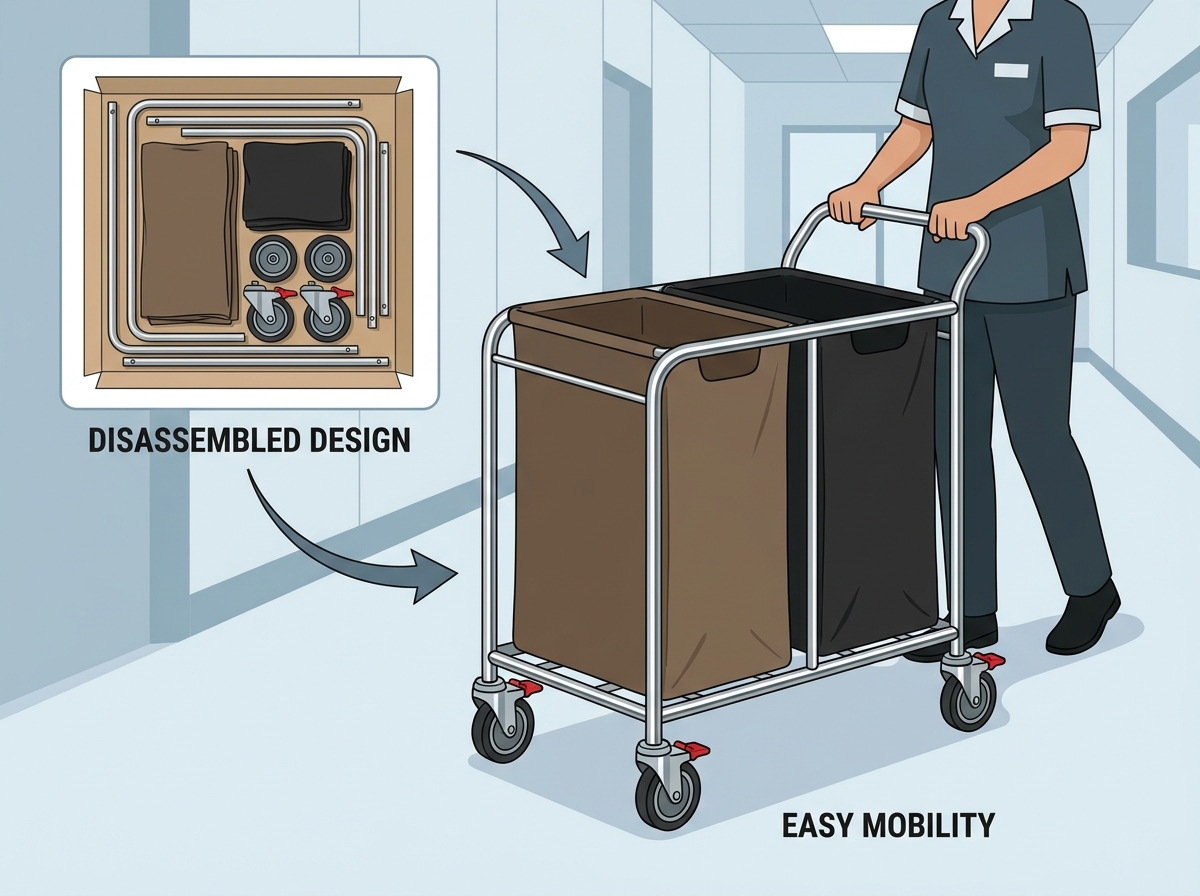
Shipping large, fully assembled commercial equipment can be prohibitively expensive due to the massive volume of space it occupies in transit. To mitigate these costs and simplify logistics, many high-quality carts feature a disassembled design. By shipping the equipment in a broken-down state, manufacturers can drastically reduce the package dimensions. This compact packaging not only lowers freight charges but also makes it significantly easier for facility staff to receive, handle, and move the boxes to the designated assembly area. A well-engineered disassembled design ensures that the components fit together precisely and securely during assembly, resulting in a final product that is just as structurally sound as a factory-welded unit, while offering superior logistical advantages.
To maximize the return on investment, facility managers must implement routine maintenance protocols for all transport equipment. Regular inspections should be conducted to ensure that all fasteners remain tight, the frame is free from damage, and the bags are intact. The wheels require particular attention; they should be regularly cleaned to remove hair, lint, and debris that can wrap around the axles and impede rotation. The braking mechanisms must also be tested to ensure they engage and disengage smoothly. By adhering to a simple but consistent maintenance schedule, facilities can extend the lifespan of their equipment, prevent unexpected breakdowns, and ensure that the carts remain safe and easy to use for their staff.
When applying the principles of effective equipment selection, it is helpful to examine a specific product that embodies these essential features. The LAICOZY / OEM Hotel Steel Laundry Trolley (Model: 3455400) serves as a prime example of a specialized transport solution designed to meet the rigorous demands of commercial facility management. By analyzing its verified specifications, we can see how engineering choices directly translate into operational benefits.
The LAICOZY / OEM Hotel Steel Laundry Trolley is explicitly designed for the demanding tasks of laundry collection and transport. Operating under the model number 3455400, this trolley is built to serve as a reliable workhorse in hospitality environments. The overall dimensions of the fully assembled unit are 74 x 62 x 92 cm. This footprint is carefully calibrated to provide substantial carrying capacity while remaining compact enough to navigate standard hotel corridors and doorways without causing obstructions. The height of 92 cm is particularly notable, as it falls within an optimal ergonomic range, allowing most users to push the trolley comfortably without excessive bending or reaching.
The construction of this trolley focuses heavily on durability and functional efficiency. The frame material is steel, chosen for its high load-bearing capacity, and it features a polished finish. This polished steel tubular frame not only ensures structural rigidity but also provides a sleek, professional appearance that is easy to clean and maintain.
For collection and sorting, the trolley includes two separate bags. To aid in visual organization, these bags are color-coded—one brown and one black. This dual-bag system allows staff to separate different types of linens immediately at the source. Crucially, these bags feature a waterproof lining, ensuring that damp towels or wet linens do not leak through, thereby protecting the steel frame from moisture and keeping facility floors clean and safe.
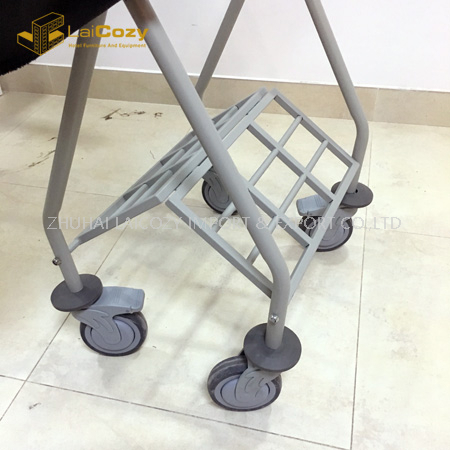
Mobility is handled by a robust caster system. The trolley is equipped with 4 universal wheels, providing the 360-degree maneuverability required to navigate tight spaces effortlessly. To ensure safety and stability during loading and unloading, 2 of these universal wheels are equipped with brakes, allowing the trolley to be securely parked precisely where the staff needs it.
Logistics and storage are streamlined through the product's packaging strategy. The trolley features a disassembled design to facilitate easy transportation. By requiring assembly upon arrival, the manufacturer is able to package the entire unit highly efficiently. The trolley is packaged as 1 piece per package, with all components—including the bag and wheels—included in a single carton. The resulting package dimensions are a compact 75.5 x 61.5 x 15.5 cm. This optimized packaging significantly reduces shipping volumes and makes it simple for facility receiving departments to handle and store the boxes before assembly.
Procuring high-quality equipment is only the first step; maximizing its value requires integrating it effectively into your facility's daily operations. Establishing clear protocols and best practices ensures that the equipment is used safely, efficiently, and in a manner that prolongs its operational life.
Comprehensive staff training is essential when introducing new equipment. Employees should be instructed on the ergonomic best practices for pushing and steering the carts to minimize physical strain. Training must also cover the proper use of the braking systems, emphasizing the importance of engaging the brakes whenever the cart is left unattended or during the loading process. Furthermore, staff should be educated on the specific sorting protocols utilizing the multi-bag systems, ensuring that the visual cues (such as using the brown bag for towels and the black bag for sheets) are consistently followed across all shifts.
Given their role in transporting soiled linens, these carts must be integrated into the facility's overall sanitation program. A strict cleaning schedule should be established, requiring the daily wipe-down of the polished steel tubular frame with appropriate disinfectants. The waterproof linings of the bags should also be regularly cleaned and sanitized to prevent the buildup of odors and bacteria. By maintaining the cleanliness of the equipment, facilities uphold their hygiene standards and present a professional image to guests who may observe the staff working in the corridors.
When evaluating procurement options, facility managers must look beyond the initial purchase price and consider the total cost of ownership. Investing in durable, well-engineered equipment yields significant long-term financial benefits through reduced replacement costs and enhanced operational efficiency.
The lifespan of commercial transport equipment is directly correlated to the quality of its materials and construction. A cart built with a polished steel tubular frame will inherently outlast cheaper alternatives made from inferior plastics or thin-gauge metals. The inclusion of high-quality universal wheels and durable, waterproof-lined bags further extends the operational life of the unit. While premium equipment may require a slightly higher initial investment, its ability to withstand years of rigorous daily use without failing makes it the more economically sound choice over time.
Frequent equipment failures not only disrupt daily operations but also incur continuous replacement costs. Every time a cart breaks down, labor is wasted, and capital must be expended to procure a replacement. By selecting robust equipment designed specifically for the demands of commercial laundry transport, facilities can drastically reduce the frequency of these replacements. The disassembled design and efficient packaging also contribute to cost savings during the initial procurement phase. Ultimately, choosing reliable equipment is a strategic financial decision that protects the facility's budget and ensures uninterrupted service.
Finding the right supplier is just as important as selecting the right equipment. Facility managers should seek out manufacturers and distributors who specialize in commercial-grade hospitality and healthcare supplies. When expanding your fleet of transport equipment, it is beneficial to review comprehensive catalogs of Laundry Carts to compare specifications, materials, and configurations. Partnering with reputable suppliers ensures access to high-quality products, reliable replacement parts, and consistent customer support, all of which are essential for maintaining a smooth and efficient operational workflow.
The LAICOZY / OEM Hotel Steel Laundry Trolley (Model: 3455400) presents a highly effective, professional-grade solution for commercial laundry collection and transport. Its polished steel tubular frame guarantees exceptional durability and a clean aesthetic, while the inclusion of two separate bags (brown and black) with waterproof linings enables efficient, hygienic pre-sorting of damp and soiled linens. The combination of 4 universal wheels—including 2 with brakes—ensures effortless maneuverability and secure parking in busy environments. Furthermore, its disassembled design and compact packaging (75.5 x 61.5 x 15.5 cm) facilitate highly efficient shipping and easy handling upon delivery. With overall dimensions of 74 x 62 x 92 cm, this trolley is perfectly proportioned to enhance workplace ergonomics and streamline daily housekeeping operations, making it an invaluable asset for any facility focused on efficiency, safety, and long-term reliability.